|
|
 |
Find A Hotel
Select a Location
|
|
|
|
 |
 |
Home » The Chardham
Camps » Overview
The Chardham Camps - Overview
Set up in the year 2003 for the first time, "The
Chardham Camps" pioneered the concept of integrated
luxury pilgrimage travel in a market yet untouched by any
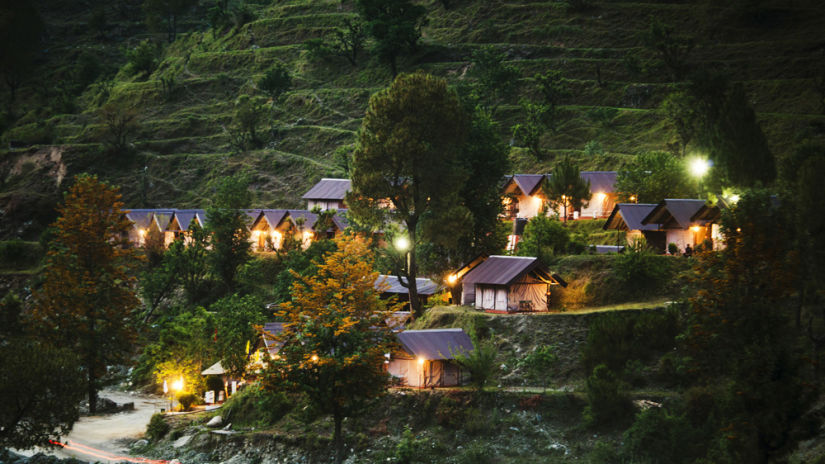
quality service outfitter. The camps provide luxury
accommodation in Swiss cottage tents with attached baths and
showers for the first time in the history of the Chardham
Circuit.
Not Just an accommodation
At The Chardham Camps hospitality is not restricted just to
sumptuous cuisine, hygienic and comfortable accommodation. It
goes beyond this established norm. The guests decide how they
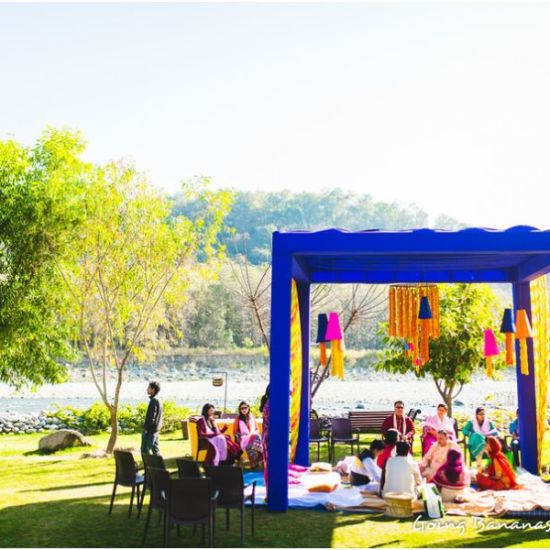
want to define their holiday. Guests are offered a glimpse of
the local culture & heritage and a variety of activities
to choose from. Some of the options available are:-
- Evening Arti by Local Priest
- Bhajan & Kirtan
- Bonfire everyday in the evening
- Cultural evening at Joshimath every alternate day
- Guided trek at Harsil
- Visit to Chopta & a trek to Tungnath near Guptakashi
- A traditional welcome with a wet towel awaits you on your
arrival at the camps
"The Chardham Camps" can thus be adjudged as the
best alternative to luxury hotels in Chardham. Set amidst the
serenity of the plush flora, The Chardham Camps promises you
the finest accommodation in Chardham . So get set to enjoy
your Chardham yatra amidst the folds of snow-covered peaks of
the lofty Garhwal Himalayas.
Barkot
(Altitude: 2118 mtrs) is located on slightly raised land
along the banks of the Yamuna in the area that is known as the
Rawain essentially the valley of the River Yamuna. The
most striking aspect of Barkot is its natural setting a
backdrop of the magnificent Banderpunch range and verdant
hills and terraced fields in the foreground. Nature was
preserved here in its pristine glory as it was only in the
1940s that outsiders in the form of trekkers and adventurers
finally managed to make their way to this remote region. The
people of Rawain trace their genealogy down from the Pandavs
and the Kauravs of the Mahabharat fame. As a result, this is
one of the few areas in India where fraternal polyandry, the
marriage of multiple brothers to a single woman, is practiced.
For most people in Barkot, polyandry is a natural way of life.
In the generation before the present one, polyandry was
practiced as a matter of fact; and many of the present
generation find it natural that they have several fathers and
one mother. The practice is now dying out in the more
urbanised area such as Barkot but continues to be prevalent in
the surrounding villages.
Harsil
At an altitude of 2745 meters ,20 Kms before Gangotri there
is only one word to describe Harsil: stunning! It is situated
in a valley on the bank of river Bhagirathi, at the confluence
of the Jalandhari Gadh and the Bhagirathi, nestled in the
shadow of the huge mountain that lies at the head of the Baspa
Valley (Himachal Pradesh). Harsil is connected to the Baspa
valley by several passes such as the Lamkhaga Pass. Apart
from Matri and Kailash mountains, on the right side there is
the Shrikanth peak behind which lies Kedarnath and in the rear
there is Banderpunch. This sylvan hamlet is well-known for its
natural beauty and delicious apples. The winding shady roads,
tall conifers, lofty mountains, the turbulent Bhagirathi,
apple orchards, streams, waterfalls and green meadows -- all
add to Harsils allure.
A narrow lane runs through Harsil and is bordered on both
sides by wooden houses in typical Garhwali architectural
style. There are little streams, swept by willow tress, with
dainty bridges across them and forest trails you can follow to
your hearts content. Harsil lay on the old caravan trail
between Tibet and India, when trade and marriages flourished
between the two countries. Harsil has a sizeable Bhotia
population many of whom use Harsil as their winter
base.
The army has a strong presence in this town and an army
camp is based here perhaps because Harsil lies quite close to
the China border.
Dharali
3 Kms from Harsil at an altitude of 2800 meters Dharali, a
small, picturesque village, could be called a suburb of
Harsil. Its rajma (red kidney beans) and apples are famous in
the region, including a variety called Wilson obviously
named after. Frederick E. Wilson , who settled here in the
early 19th century and introduced the residents to potato- and
apple-growing.The Bhagirathi flows close by and the village is
surrounded by pine trees with a breathtaking view of
snow-clad peaks.
Dharali is the last village on this side of the Indo-Tibetan
border and has a strong Tibetan influence; there is a
permanent settlement of semi-nomadic Jadhs of the Nilang
valley here.
Maneri
Roughly 13 km upstream of Uttarkashi is the village of
Maneri. Here, a lake of an unbelievably beautiful and
clear colour reflecting the surrounding conifers-- has been
formed by damming the Bhagirathi, which is fast becoming a
popular tourist attraction. The Maneri-Bhali project, which
supplies 93 MW of power to Uttarakhand, is located on the left
bank of Bhagirathi, close to Uttarkashi.
Guptakashi
Located at an altitude of 1319 meter Gupkashi offers a
panoramic view of the Mandakini valley below, Chaukhamba,
Mandakini Darshan, Badrinath, Neelkanth, Ukhimath and the snow
ranges of the Kedarnath atop ahead. It is a major town before
Gaurikund with services and facilities of a post and
telegraph office, banks, a hospital, a police station and
eateries.
The temples in Guptkashi are believed to be as old as time
itself.Barely a kilometre or two down from Guptkashi, on the
track to Ukhimath, is the Vidyapeeth, the most historic
Sanskrit and Ayurved school in the entire state. It is no
wonder that Guptkashi has a rich tradition of Ayurved practice
and a host of Ayurvedacharya or practitioners of Ayurved.
Joshimath
Located at an altitude of 1875 meters Joshimath is the place
where Adi Shankracharya, the 8th century religious reformer,
attained enlightenment, and it is here that he set up the
first ever Math or centre of learning before establishing the
Badrinath shrine and three more Maths in different corners of
the country. The town is also the seat of the Badrinath shrine
in the winter months, and it is worshipped at the beautiful
and ancient Narsingh Temple here. Its proximity to Badrinath,
Auli and Niti Valley makes Joshimath an important tourist
destination and the combination of spiritualism and
adventure that it offers visitors makes it an exciting place
at any time of the year. |
|